Showing posts with label Tutorial. Show all posts

Tuesday, March 11, 2014

Tuesday Tutorial with Lucy of The Farmer's Attic

How to Make Faux Chenille
Making faux chenille is relatively easy. You will need 4 layers of fabric. In the example, I have used 4 layers of flannel but you can also use cotton as shown at the end of the tutorial.
I have cut four different pieces measuring 12" square. Layer each piece on top of each other, right sides facing up. Pin baste so the layers won't shift. Mark a diagonal sewing line from one corner to another using either a washable fabric marker or an air erasable marker. Sew on your diagonal line using your walking foot. Either mark a sewing line 1/2" away from the original sewn line or use your sewing foot as a guide. Sew diagonal lines 1/2" apart until the entire piece is completely sewn.

Using either a Chenille cutter or a pair of scissors, cut through three layers of the fabric between each stitched line. Be careful to only cut 3 of the 4 layers.
After chenille fabric has been stitched and cut, you can mark, cut and sew your pattern to create a chenille pillow, animal, etc.

For the bunny shown below, I sewed two 12" pieces of chenille, marked my bunny pattern on the back, cut and sewed them together.

After your piece has been sewn together, stuffed and hand stitched closed, simply throw your piece in the washing machine with a couple of large towels. Toss them in the dryer. Once dried, the chenille will become fuzzy. The more you wash and dry the fuzzier and softer it will become.

As you can see in the following picture, you are not limited to simply sewing diagonal lines. Experiment with any design.

You can also "chenille" pre-printed fabric. Just make sure you layer each panel directly on top of each other. The last layer should be face down and the three layers face up. As you can see, the design, once cut, maintains its original pattern. You can do this for rugs, placemats, table runners, baby blankets,
etc. Use your imagination.


Thank You for sharing Lucy!
You can find Lucy here:

Tuesday, October 30, 2012

The Gnome Home Tutorial by Baggaraggs

Ok Class, take your seats...Not PICK your Seats...(giggle)

Today we will work on making a Traditional Gnome Home Gift Envelope from those Trusty Paper bags you painted some days ago...RIGHT!!!!
These Colors are, I think, Typical for the Gnomes that Live at the Baggaraggs, I think I might have an Alpine group of them, since they seem to go for a Swiss Look, and I can hear periodic Yodeling...
So we started with a green painted Grocery bag. Pictured here with my Trusty PINKERS:
I cut out a shape that I felt would be slightly longer then what I wanted because the back part of the house will be cut so the front part of the house can form a closure lip. I know that sounds complicated but I took a PHOTO and I will show that part to you in just a minute.
HOLD YOUR HORSES!!!
Here is the house shape I cut. EYEBALL IT. For those of you who do not wish to EYEBALL It, The house is 12 inches tall and about 6.2 inches wide.
Ok. NOW, we will cut a piece off the bottom of the back of the HOUSE. Like this:

 here is what the Back looks like folded up. It would be better if my photos didn't SUCK but...I am trying my best. FOLD That Bottom Part back, so that it makes the LIP of the envelope. The crease will be the line where your Door will be situated.
 
Now the Wild Rumpus STARTS...Begin to sew on your embellishments with the largest pieces first. I started with a Polka-dot taffeta Gable. AGAIN use a ZIG-ZAG or satin Stitch. a Straight stitch will cut the paper.
 
 Build your gable and doorway as you see fit.
I put a piece of vintage netting over the finished gable with sparkles inside. I would actually not suggest the sparkles or GLITTER as the Net did not secure them and they delivered their magic onto me at intervals...spilling out little bits of silver stars...I did also put a vintage stamp there in the gable, and The Gnomes said that was alright...the Stamp is from Bulgaria, and one of them has a sister from there.
Make your Doorway
as the actual door and some vintage lace as a door frame.
I also added some Bricks to the side of the walls.
You can see there that the door is not situated on the bottom of the house. Its because that Bottom part gets folded backward to make the closure of the envelope.
At the Bottom of the front of your HOUSE, sew your seam binding on the raw edge of the lip of the envelope. DOWN at the bottom where it will be folded backward.
Here it is sewn on and folded to the back. Set your Grommet now and sew on a button to the back of the house where your string can close the envelope securely. It looks like this on mine:
Now...sew your One side seam, beginning with the roof and down the side.
Sew down to the bottom of the wall of the house but STOP when you reach the part that folds over.
Iron it. You can cover it with a dish towel if you want to protect your IRON. Make sure that the Lip is folded backward on the bottom. I added a tag and a rusted bell at the roof. Gnomes are just crazy about BELLS. My tag says Dear Santa, so this envelope could hold the secret wishes of That part of your self that is and always will be a Child.
In the Classroom of the Baggaraggs there are NO MISTAKES. We celebrate Imperfection Here.
Ok?
CLASS DISMISSED!
( I always wanted to say that TOO!)
 
Thanks Robin for such a fun Tutorial!!
 
You can find Robin here:
http://baggaraggs.blogspot.com/
http://www.etsy.com/shop/Baggaraggs
 

Tuesday, August 28, 2012

Tuesday Tutorial with Karen of Buttons in the Attic

A Galaxy of Stars by Karen of Buttons in the Attic

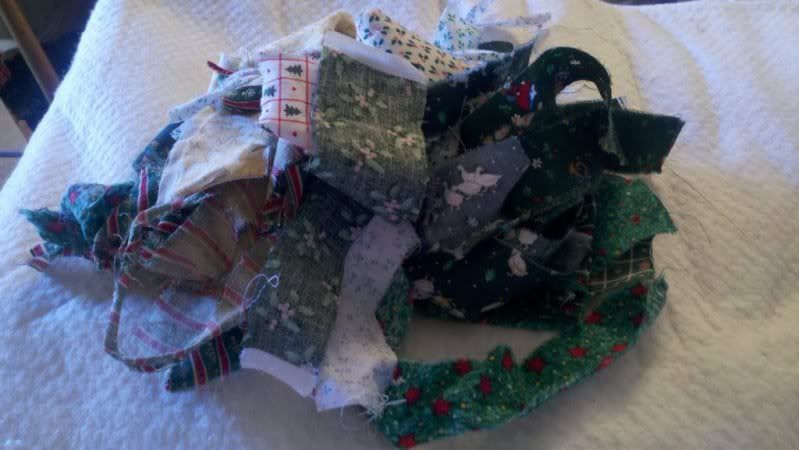
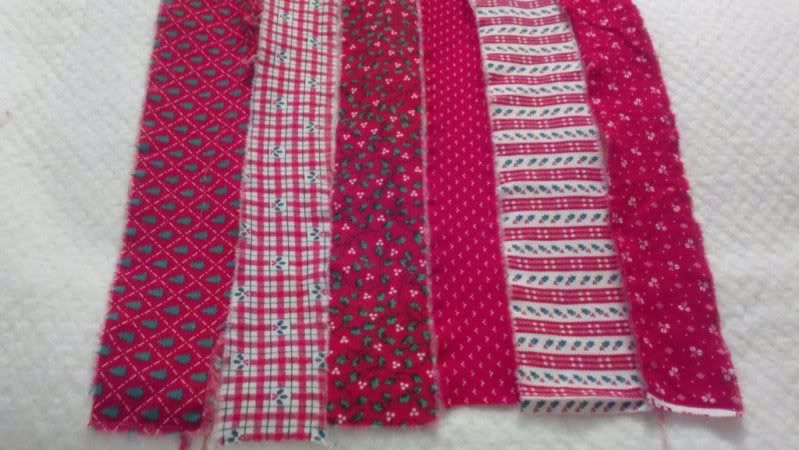
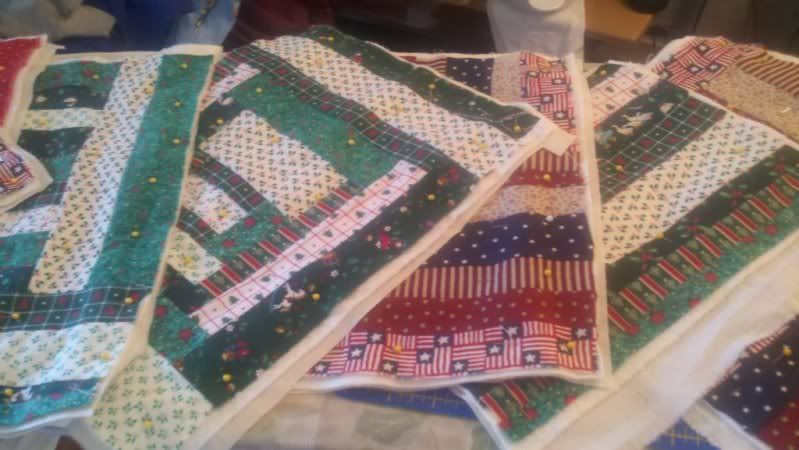
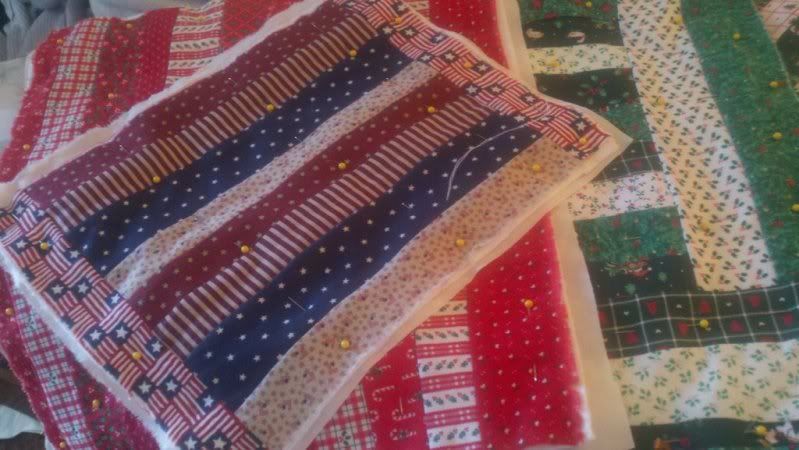
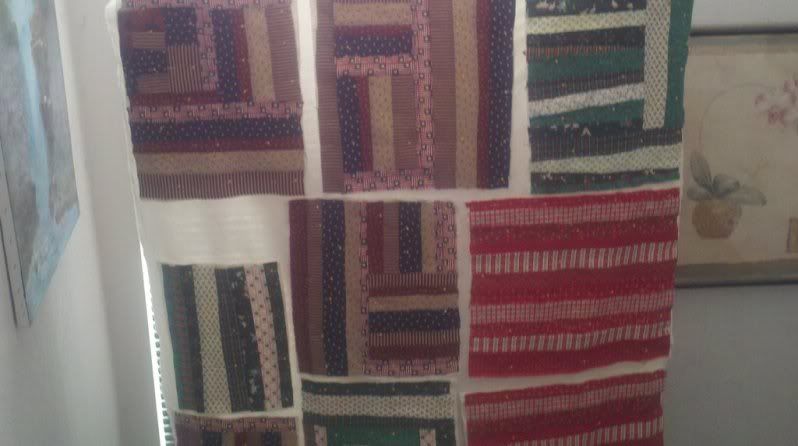
I love the look of cutter quilts on prim items and while I love the look, I am loathe to cut up antique quilts, so I make my own! I just tear up strips of fabrics and utilize my scraps to make them. I am working on Christmas stars made from green and red ticking and here are piles of torn fabric to make the cutter quilts for the stars--
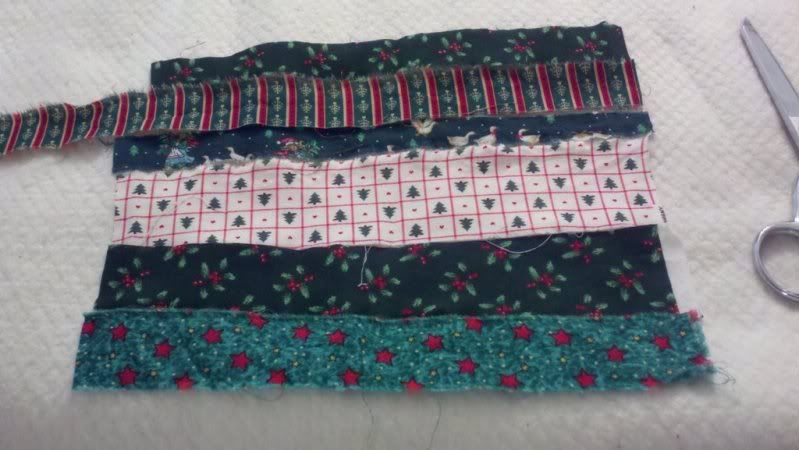
Cutter quilt ideas--I love playing around with the strips--do I do planned combinations or just let them happen as they may??
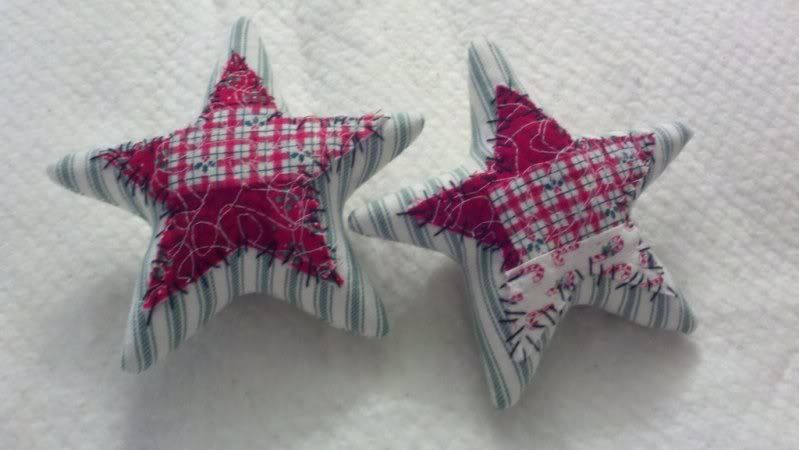
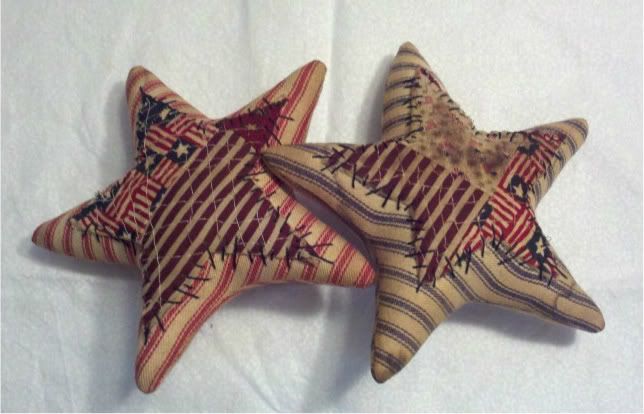
Here are a couple of finished ticking stars, just waiting to be tea stained and dried.
 
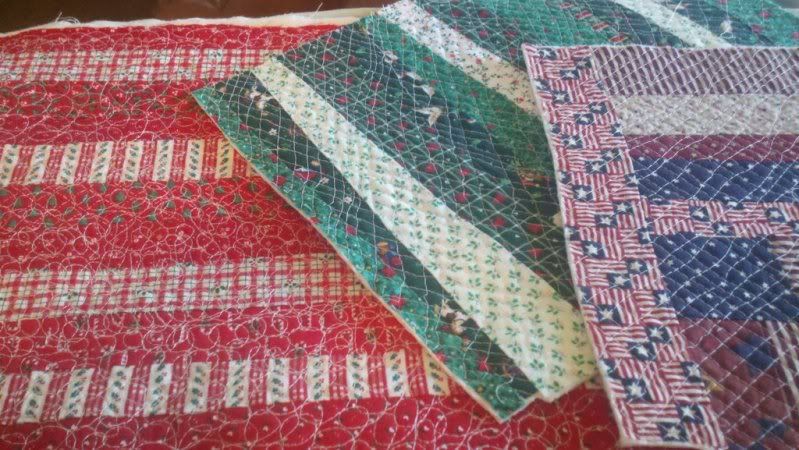
 Here they are quilted up! I used my free motion foot to do the quilting with--I thought that the randomness of the stitches really added to the 'primness' of the cutter quilts. I could just imagine a mom on the farm hurriedly stitching up a quilt to keep her family warm, wishing for the time and resources to create a master piece, such as a Baltimore quilt, and dreaming of the time when life would slow a bit so she could ply her needle at her craft.
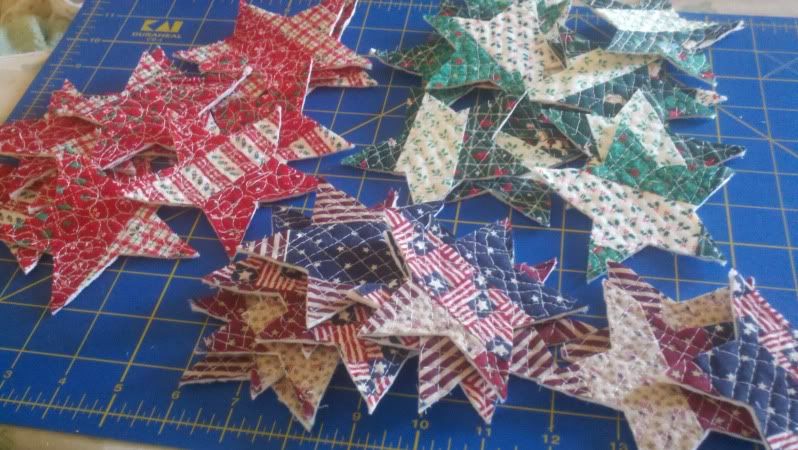
Then, after stitching the cutter quilt sections, I traced the smaller star on the back of the cutter quilt pieces to make them more random in shape and fabric placement. Here are some of the red, green and patriotic stars after they were cut out and are ready to sew onto the ticking stars!
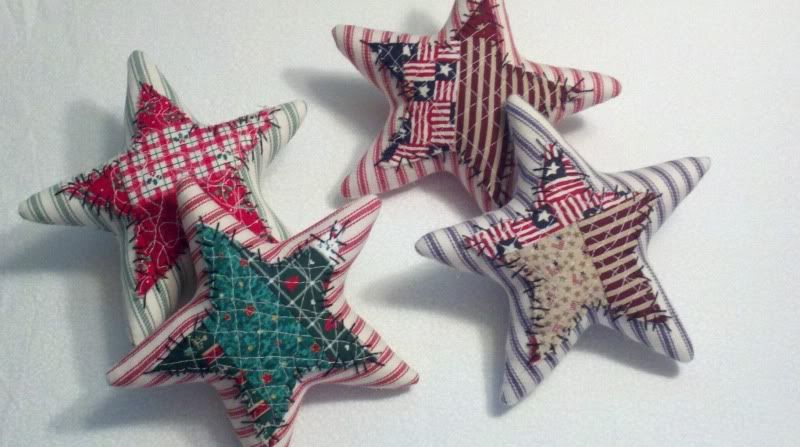
Here the ticking stars with the patchwork stars stitched on, waiting to be tea-dyed.
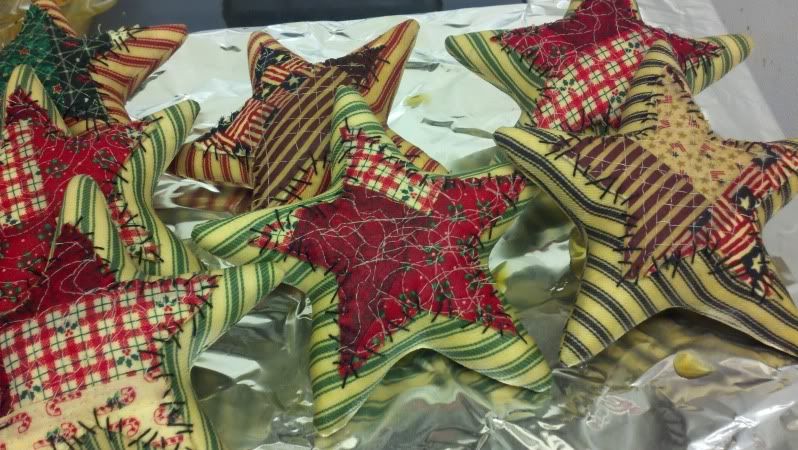
Here they are after being dunked in my tea-dye solution, waiting to be baked to prim perfection! I like to use a rather strong solution of tea and I bake my items at 200 degrees, turning every 10-15 minutes or so, until dry. I like to lay drier pieces against ones that are still damp to get water marks, as if they had been in a chest or box that had gotten damp over the years.
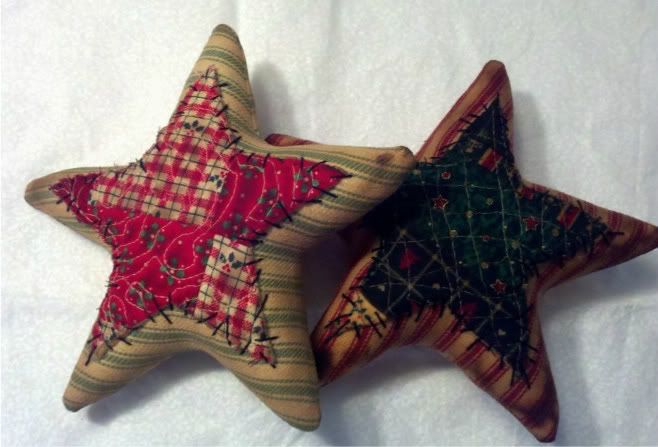
And, last but not least, here are the stars, baked and cooled and ready to fly to new homes!
I hope you have enjoyed a peek into my creative process, as much as I have enjoyed sharing it with you!
Thank you Karen for sharing this wonderful tutorial with us!
Karen can be found here:

Tuesday, July 31, 2012

Tutorial on Printing Photo Frames By Mulberry Creek

Melissa of Mulberry Creek has graciously share her printing on photo frames tutorial with us.

Frame Before Painting

These three frames are screen printed using a cream color ink on black.

 The frames are 14" X 14" with a beveled edge and a keyhole slot in the back for hanging. This is a new larger frame that more easily facilitates a larger saying or quote.

After the frame has been cut, sanded, and beveled, it is ready for paint. Each one is then painted by hand and allowed to dry overnight.

Before the frame is placed under the screen for printing it is very lightly sanded and any paint removed from the back. We then go over it with a tack cloth to remove any dust particles left from sanding. After loading the screen with ink, the frame is then placed underneath and the squeegee is drawn down over the screen forcing the ink through the design and onto the surface of the frame.

After the ink is applied the frame is then removed and placed on a drying rack to dry overnight. After the ink is thoroughly dry we then apply a coat of a satin polycrylic varnish.

Clips and foam board are then inserted in the photo opening.

Fairytale Frame


Family Roots Frame


Once in A Lifetime Frame


Thank You Melissa for sharing this tutorial with us.
Please visit Melissa at Mulberry Creek here:
http://www.etsy.com/shop/MulberryCreek
http://mulberrycreek.blogspot.com/


Tuesday, July 10, 2012

Fall Round Fabric Basket Tutorial

This is a good table size basket and besides Halloween candy,  you can fill it with apples or other fruit.   It would make a nice basket for dinner rolls on the holidays,  too.
Feedsack images, courtesy of Deena Davis,  are available at:
 
Supplies To Make one 9 inch Basket
Finished size 9 inches in diameter and 9 inches high
Main Fabric----------1/2 yard
Lining Fabric---------1/2 yard
Heavy Duty Sew-In Interfacing----28 inches x  22 inches
1--8 ½ x 11 pieces of freezer paper
2--8 ½ x 11 pieces of tea-dye muslin
Matching thread
For each basket:
Cut 1 --9 inch circle from main fabric
Cut 1 --27 ½ inch x 9 inch side panel from main fabric
Cut 1 --9 inch circle from lining fabric
Cut 1 --27 ½ inch x 9 inch side panel from lining fabric
Cut 1 --9 inch circle from heavy duty interfacing
Cut 1 --27 ½ inch x 9 inch side panel from heavy duty interfacing
Printing the image.
     You can buy fabric sheets that are ready made for printing on or print the reversed images that are included on to iron-on transfer paper which you then iron on to muslin.
     You can also iron your muslin to the same size freezer paper  and print directly on to the fabric.   I recommend an Epson printer and Epson durabrite ink which is permanent if you are going to do this as most other inks will wash out.    
Print the feedsack image onto fabric:
     Cut  the printed image out,  leaving ¼” seam allowance all around it.    With right sides together,   lay the image on a same size piece of muslin.    Stitch around,  leaving a 2” opening for turning.   Turn right side out and press.   
   You can also print the reversed images on to fabric transfer paper and then iron the image on to the front panel.
DIRECTIONS:
Layer the main fabric and interfacing circles together with the fabric facing right side up.    Pin together and then zig zag them together around the outside edge. 
 
With the right sides together,  pin the main side panel to the interfacing.   Stitch together all around the outside edge.
Pin the image in the middle of the main fabric side 3/4 inch up from the bottom.   Stitch it to the main
fabric.  
 
Now fold the panel over with right sides together so that the side seams meet and the seam is aligned together.    Pin and then stitch in a ¼ inch seam.
With the right sides together,   pin the circle to the side panel at the bottom.
With the circle against the feeddogs and using a ¼ inch seam allowance,   stitch around the seam.
 
Turn the basket right side out.
Make the lining basket the same as the main basket but eliminating the interfacing.   Leave the lining wrong side out.
Set the main basket inside the lining basket.  The right sides will be together.
Pin main basket to lining.   
Stitch in a ¼ inch seam,  leaving a 5 inch opening for turning. 
Turn the basket right side out through the opening.  
Pin the basket and lining together evenly across the top.   Fold the open edges in ¼ inch and pin.   This opening will be sewn closed as you stitch around the top.
Topstitch along the outside edge and your basket is finished.    Turn the top down to form a cuff if desired. 
SIX INCH BASKET:
Supplies To Make 1 Basket
Finished size:   6 inches diameter x  6 inches high
Main Fabric----------1/3 yard
Lining Fabric---------1/3 yard
Heavy Duty Sew-In Interfacing----22 inches x  22 inches
1--8 ½ x  11 pieces of freezer paper
2--8 ½ x  11 pieces of tea-dye muslin
Matching thread

For each basket:
Cut 1 –6 ¾  inch circle from main fabric
Cut 1 –20 3/4 inch x 7 inch side panel from main fabric
Cut 1 --6 ¾   inch circle from lining fabric
Cut 1 --20 3/4 inch x 7 inch side panel from lining fabric
Cut 1 --6 ¾   inch circle from heavy duty interfacing
Cut 1 --20 3/4 inch x 7 inch side panel from heavy duty interfacing
Assemble the same as the bigger basket.

©  2009  Bette Shaw  -  All rights reserved

Thank You Betty for sharing this tutorial with us!
Betty can be found here: